Peri Bottles, Compared: Upside-Down vs. Hospital-Style (and Who Can Skip the Upgrade)
Upside-down vs. hospital-style peri bottles: our research on the best peri bottle for postpartum recovery, and when the free one is enough.

Quick summary
Upside-down vs. hospital-style peri bottles: our research on the best peri bottle for postpartum recovery, and when the free one is enough.
Key takeaway
Take it one day at a time. You're doing better than you think.
The spirit
“It gets better, promise.”
BloomCare Editorial
Trusted pregnancy and postpartum educators
Nobody mentions the peri bottle until suddenly it's the most important object in your bathroom. If you're here searching for the best peri bottle for postpartum recovery, you're probably somewhere between "packing the hospital bag" and "week one, and wow, nobody warned me." Either way, you're in the right place, and this decision is smaller and easier than the internet makes it look.
Here's the honest version up front: the free bottle the hospital sends home works. The upgraded upside-down bottles are genuinely more comfortable. Which one deserves a spot in your bag depends on your recovery, your budget, and how much you value not contorting on a toilet at 3 a.m.
This guide is part of our complete guide to perineal care after birth, where the full healing routine lives. This page covers just the bottle decision: properly.
BloomCare shares product research and education, not medical advice. Every recovery is different, and your provider knows yours best. For anything that worries you, that's always the right call.
The short answer
A peri bottle rinses your perineum with warm water so you can clean and soothe the area without wiping. Hospital-style bottles are upright and require aiming from the front; upside-down bottles have an angled spout that reaches without leaning. If you had stitches, a tear, or a C-section, or you just want easier, the upside-down style is worth it. If money is tight, the hospital freebie covers you.
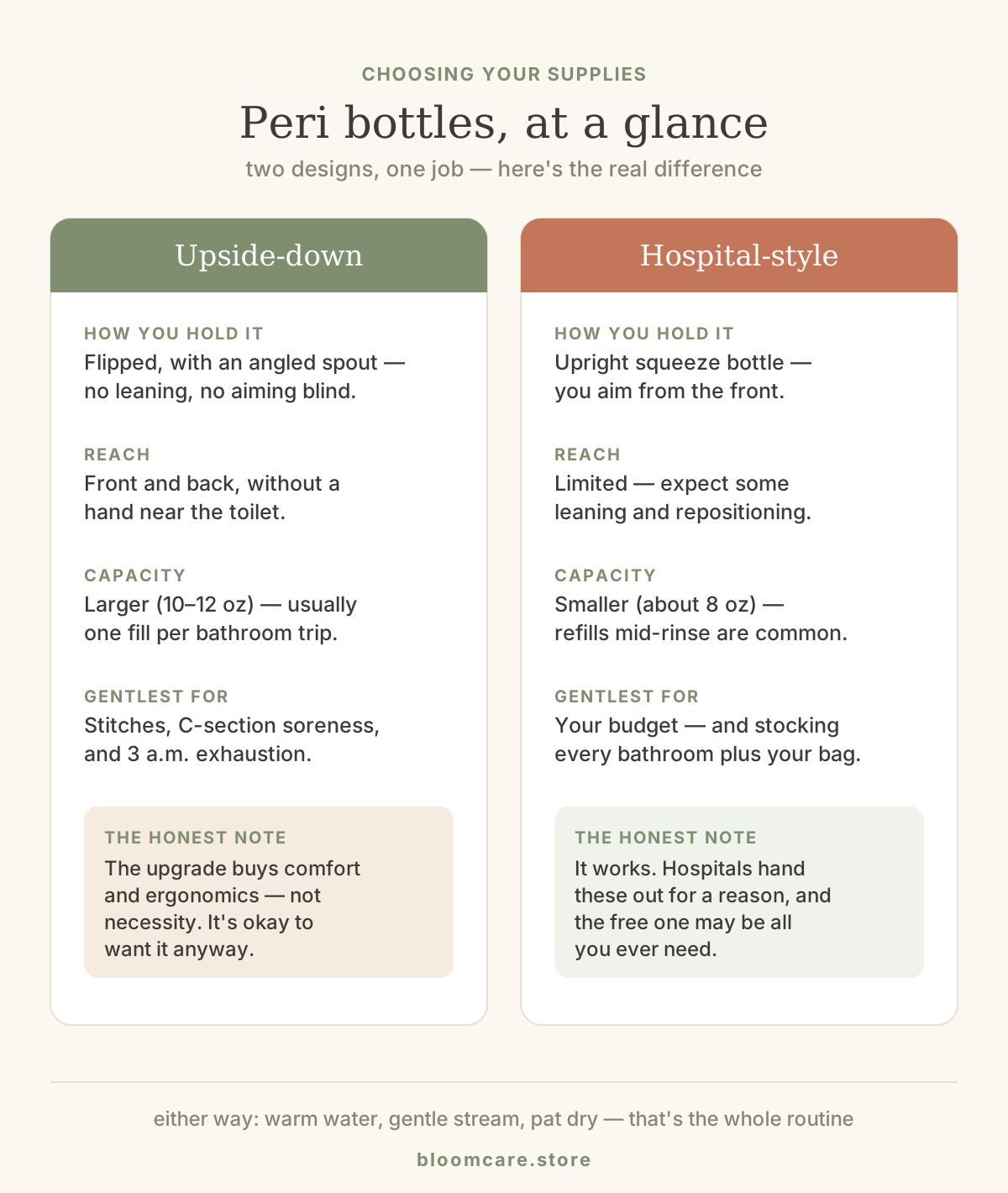
Upside-down vs. hospital-style at a glance
| | Upside-down bottles | Hospital-style bottles |
|---|---|---|
| How you hold it | Flipped, angled spout does the aiming | Upright, you aim from the front |
| Reach | Front and back, no hand near the toilet | Limited: expect some leaning |
| Capacity | Larger (10–12 oz), usually one fill per trip | Smaller (about 8 oz), mid-rinse refills |
| Easiest with | Stitches, C-section soreness, exhaustion | A healed-enough body and a tight budget |
| After recovery | Doubles as a travel bidet | Backup bottles for every bathroom |
Why a squeeze bottle is the tool for this job
In the first days after a vaginal birth, your perineum is swollen, tender, and possibly stitched, and it still has to share space with every bathroom trip. Wiping is the enemy. That's why ACOG's postpartum pain guidance recommends cleaning with warm water from a squeeze bottle while you're on the toilet, which can also make urination sting less by diluting the flow. MedlinePlus offers the same aftercare advice for anyone healing from an episiotomy: spray warm water over the area after you go, then pat, never rub, dry.
So the question isn't whether a rinse bottle belongs in your recovery. The hospital will likely hand you one on the way out. The question is whether the one they hand you is the one you'll want to use six times a day.
How we researched this
We don't accept sponsorships and nobody pays for a spot on our lists. For this comparison, we read the pattern across tens of thousands of Amazon reviews of the most-used peri bottles (including the one- and two-star reviews, which is where the truth usually lives) and checked every design claim against what recovering mamas actually report. Facts about each product below come straight from its listing; the verdicts come from that review pattern.
you're allowed to make this one thing easier
A quick, honest note: if you buy through links in this journal, BloomCare may earn a small commission, at no extra cost to you. Nobody pays for a place on our lists, and our research is done before we ever look at a link.
Our research: the best peri bottle for postpartum recovery
The upside-down standard: Frida Mom Peri Bottle
What it is: A 10 oz BPA-free bottle with an angled neck designed to be used upside down, so the spray reaches where you need it without contorting or putting a hand near the toilet. The listing notes the design also avoids pressure on C-section soreness, and it comes with a travel bag.
What the reviews say: Across roughly 29,000 ratings, the pattern is remarkably consistent: the upside-down angle is the whole product, and people recovering from tears, stitches, and C-sections describe it as the thing that made bathroom trips manageable on no sleep. The recurring complaints are practical rather than functional: the included travel bag isn't waterproof, so a still-damp bottle will leak in your hospital bag (pack it dry, or in a zip-top bag), and a few report drips when the cap isn't seated properly. A small but honest minority says the free hospital bottle served them just fine.
Worth it if: You have stitches or a tear, you're recovering from a C-section, or you want the version of this chore that requires the least bending, aiming, and thinking. Skip it if: You're comfortable using the hospital freebie and don't mind the awkward angle: the upgrade is about ergonomics, not necessity.
See the Frida Mom upside-down peri bottle
The bigger-capacity alternative: Lansinoh Peri Bottle
What it is: A 12.2 oz upside-down bottle (the largest of the mainstream options) with an angled spout that extends for hard-to-reach areas. It includes a carry bag, is FSA/HSA eligible per the listing, and comes from Lansinoh's birth-prep and recovery line.
What the reviews say: Across roughly 1,400 ratings, reviewers tell the same story as the Frida crowd (vastly better than the upright hospital bottle) with the extra capacity called out as the reason to pick this one: heavier rinses on a single fill, no mid-trip refill shuffle. The complaint that repeats is leakage when the lid isn't threaded carefully. And one cautionary tale worth passing on: this bottle cannot be sterilized in boiling water (a reviewer tried; it melted). Warm soapy water is the way.
Worth it if: You want the angled-spout comfort and the most water per fill, or you already trust Lansinoh from their nursing products. Skip it if: Capacity isn't a pain point for you: if refilling doesn't bother you, the smaller bottles do the same job.
See the Lansinoh upside-down peri bottle
The hospital-style option: Medline Peri Bottles (3-pack)
What it is: A three-pack of the clear 8 oz upright squeeze bottles hospitals commonly use for postpartum hygiene, with a lift-and-turn flow-control top. Soft plastic, easy to squeeze, easy to see how much water is left.
What the reviews say: Across roughly 4,000 ratings, the pattern is "simple thing, does its job": durable across years of use, easy to squeeze, and identical to what you'd be handed after delivery. The honest limits repeat just as clearly: the upright design means aiming from the front and leaning to reach, which is exactly the awkwardness the angled bottles were invented to fix, and 8 oz tends to run out mid-rinse. Reviewers also note the soft bottle can't build much water pressure.
Worth it if: The hospital style worked fine for you and you want one in every bathroom plus a spare for your bag: the practical, no-frills route. Skip it if: Reaching and aiming an upright bottle sounds miserable right now (stitches, incision, limited mobility): that's precisely the problem the upside-down design solves.
See the Medline hospital-style peri bottles (3-pack)
Frida peri bottle vs. the hospital bottle: what the upgrade actually buys you
Strip away the marketing and the upside down peri bottle does exactly three things the hospital bottle doesn't:
- It aims for you. The angled spout reaches front and back while you sit normally. With the upright bottle, you're leaning forward, reaching under, and hoping. With fresh stitches, that's not a small difference.
- It holds more. One fill usually covers the whole rinse. The 8 oz hospital bottle often needs a mid-trip refill, which means standing up. Enough said.
- It survives the recovery. Reviewers keep using the angled bottles long after healing (a portable peri bottle is just a travel bidet with a kinder name) while the hospital bottle tends to become drawer clutter.
What the upgrade does not buy you: better healing. Warm water is warm water. ACOG's guidance is about the rinse, not the bottle shape, so if the budget question is real for you this month, the free bottle plus patience does the same medical job. We mean that. (Our whole list of postpartum products you can skip runs on that principle.)
Recovering from a C-section instead? Your peri bottle still earns its place: those first post-catheter bathroom trips are gentler with a no-lean rinse, and the upside-down design avoids pressure near your incision. Start with our C-section recovery kit checklist for the full picture.
Questions mamas actually ask
Do I need a peri bottle at all?
If you're giving birth vaginally, plan on using one: ACOG recommends the warm-water rinse while you're on the toilet, and most hospitals hand you a bottle before discharge. The real decision isn't if, it's which: the free upright one or an angled upgrade.
Is the hospital peri bottle good enough?
Functionally, yes: it delivers warm water, which is the entire medical job. The honest trade-off is comfort: expect aiming, leaning, and mid-rinse refills. Reviewers who healed quickly often say the freebie was plenty; reviewers with stitches or a C-section usually wish they'd upgraded sooner.
What do you put in a peri bottle?
Warm water: that's it, and check the temperature on your wrist first. If you're tempted by additives you've seen on social media, run them by your provider first, and know that plain water is what MedlinePlus recommends for keeping a healing perineum clean. For soothing extras, that's what padsicles and sitz baths are for.
How long will I use it?
Most mamas use a peri bottle heavily for the first couple of weeks, while soreness and bleeding are at their peak, then taper off as healing progresses over several weeks. There's no finish line to hit: use it as long as it helps. If pain gets worse instead of better, or you notice discharge with a bad odor, MedlinePlus lists those among the signs to contact your provider.
Keep reading
- Start here: Perineal care after birth: a gentle, complete guide to healing: the full routine this bottle belongs to
- How to make padsicles, step by step: the cooling half of the comfort equation
- Sitz baths after birth: how, how often, and what (if anything) to add: for the soreness a rinse can't reach
Last reviewed: July 13, 2026 by the BloomCare Editorial Team. We re-review guides every 90 days.
Sources
continue reading
you might also like